
Information for Prospective Students
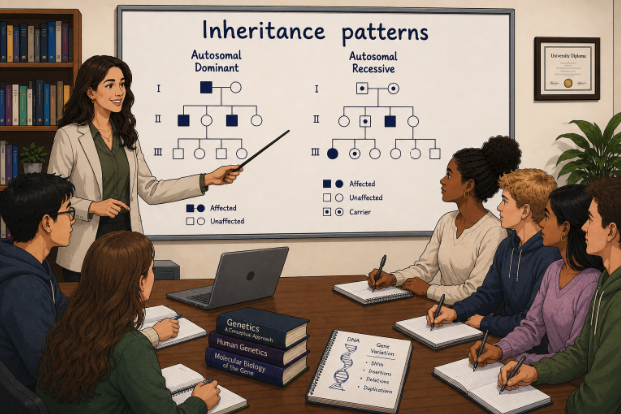
A genetic professional is a medical professional that specializes in genetic conditions. Genetic professionals can include Genetic Counselors, Medical Geneticists and Genetics Researchers.
Genetic Counselors have training in medical genetics and counseling to guide and support patients who want information about their or their family’s risk for inherited diseases and conditions. They help individuals understand their genetic testing options based on their personal and family history and explain how the results of testing can impact the health of themselves and their families. Genetic counselors have a Master’s Degree in genetic counseling and are board certified by the American Board of Genetic Counseling (ABGC).
Video Link: https://youtu.be/mhwVlCDgk84?si=CQX2mrjBX8yo12gY
Medical Geneticists are doctors that specialize in medical conditions that are hereditary or passed down through a family. They are trained to evaluate, diagnose, counsel, manage, and treat individuals and families with genetic concerns and specific genetic conditions. Medical geneticists have a medical degree and are board certified by the American Board of Medical Genetics and Genomics (ABMGG).
Video Link: https://www.youtube.com/watch?v=xx4FkwMhJK0
Genetic researchers (not to be confused with geneticists) are scientists conducting various levels of genetic research, studying how traits, diseases, and biological information are passed down through DNA.
Video Link: https://youtu.be/vrk-nAzWbEg?si=qM3rpkDWVZ1qKm5u
Some physician assistants and nurses will take on extra training and education to increase their knowledge in the field of genetics and genomic medicine. These healthcare workers can aid genetics and genetic counselors during sessions.
-
What is genetic counseling?
Genetic counseling is the process of helping people understand and adapt to the medical, psychological, and familial implications of genetic contributions to disease. This process integrates:
Interpretation of family and medical histories to assess the chance of disease occurrence or recurrence.
Education about inheritance, testing, management, prevention, resources and research.
Counseling to promote informed choices and adaptation to the risk or condition.
(Resta, R. et al. (2006). A new definition of genetic counseling: National Society of Genetic Counselors’ task force report. Journal of genetic counseling, 15(2), 77-83.)
Genetic counseling may be beneficial at various life stages, which includes planning for pregnancy, during pregnancy, childhood, adulthood, and late in life.
How do you become a Genetic Counselor?
Step One: Earn an undergraduate Bachelor’s degree
Coursework should include genetics, biology, biochemistry, psychology and statistics.
Step Two: Gain relevant experience, such as:
Shadow or meet with a genetic counselor to acquire familiarity with the field.
Volunteer at a crisis hotline, homeless shelter, hospice, etc to learn counseling skills
Volunteer at an advocacy group, children’s hospital, etc to gain experience working with individuals who have a genetic condition or disability
Attend virtual informational events such as webinars and prospective student open houses
Work in a research lab
Become a Genetic Counseling Assistant
Step Three: Earn a Master’s degree in Genetic Counseling
There are currently over 60 training programs in the United States and Canada accredited by the Accreditation Council for Genetic Counseling (ACGC)
Step Four: Obtain certification by passing the Boards exam provided by the American Board of Genetic Counseling (ABGC) and/or the Canadian Board of Genetic Counselling (CBGC).
Most employers of genetic counselors, including hospitals, clinics, and laboratories, require their genetic counselors to be certified.
Certain states require genetic counselors to have a license to practice, and having certification is needed to obtain a license.
Which universities/colleges offer genetic counseling training programs?
As of 2026, there are now 7 genetic counseling training programs located in NYS:
Columbia University Genetic Counseling Graduate Program
Long Island University (LIU) Post Genetic Counseling Graduate Program
Sarah Lawrence College Joan H. Marks Graduate Program in Human Genetics
University at Buffalo Master of Science in Genetic Counseling
Mt. Sinai School of Medicine Master of Science Program in Genetic Counseling
Weill Cornell Medical College Master’s of Program in Genetic Counseling
University of Rochester The Master of Science in Genetic Counseling Program
A complete list of accredited programs in the US and Canada with links to each program’s website can be found on the Accreditation Council for Genetic Counseling website: gceducation.org/find-a-program/
Are there any internship programs?
The Iowa Institute of Human Genetics Summer Internship in Genetic Counseling humangenetics.medicine.uiowa.edu/education-division/summer-internship-genetic-counseling#accordion-item-1111-3
8-week summer internship with a cost-of-living stipend to help cover room and board
Provides students with full-time, hands-on projects in genetic counseling and personalized genomic medicine and enrichment activities (including seminars and workshops on graduate school and careers)
University of South Carolina Summer Internship sc.edu/study/colleges_schools/medicine/education/genetic_counseling/preparing_for_graduate_school/summer_internship/index.php
Six-week summer internship with stipend
The selected intern will assist genetic counseling faculty members with case preparation, educational and administrative projects, and have the opportunity to observe genetic counseling sessions.
Basser Summer Scholars Program basser.org/internship
Paid eight-week program on campus
For undergraduate students considering careers in genetic counseling, clinical genetics and basic science
Applicants must be undergraduate students (through rising seniors) from disadvantaged backgrounds and/or first-generation low-income students.
The Johns Hopkins University Genetic Counseling Internship hopkinsmedicine.org/genetic-medicine/education-training/genetic-counseling-internship
Virtual summer internship for 10 undergraduate and recent college graduates
Provides exposure to the clinical genetics/genomics and genetic counseling fields
Interns will receive mentoring from genetic counselors, attend virtual lectures and career development activities, and participate remotely in clinical development projects
Genetic Counseling Immersive Program at Color Health color.com/genetic-counseling-programs-at-color
A fully remote, educational program designed to advance the knowledge and experience of aspiring genetic counselors
Benefits historically underrepresented members of the GC community
Greenwood Genetic Center Undergraduate Summer Experiences ggc.org/education/students/#internships
8-10 week long internships that include a stipend of $2,000. Housing is not included.
For students at all levels to explore careers and advance their genetic education.
**Please note that this list is not all inclusive and subject to change.**
Where can I find more information about Genetic Counseling?
Genetic Counselor Educators Association educategc.org/prospective-students/
A community of graduate level educators striving to advance quality in genetic counseling education.
National Society of Genetic Counselors nsgc.org/BecomeaGC
The professional organization that supports the unique needs of genetic counselors.
Genetic Counseling Experience Initiative (GCEI) IG: @gcexpinitiative
A student-organized group of prospective genetic counselors that aims to increase exposure to genetic counseling to prospective students by facilitating meaningful interactions with genetic counselors.
American Board of Genetic Counseling (ABGC) abgc.net
Offers the certification exam for genetic counselors. Visit the website to learn more about certification requirements, exam dates and practice exams.
Genetic Counseling Prospective Student Network (GCPSN) linkedin.com/company/gcpsn/
A group of prospective genetic counseling students working to create a supportive network for other prospective students through informative webinars, application workshops, and social events.
Accreditation Council for Genetic Counseling (ACGC) gceducation.org
Develops and maintains standards for educational and clinical training of genetic counseling students. Visit the website to identify accredited programs that meet your chosen profession’s standards for academic education and fieldwork training.
-
What is genetics research?
Genetics research comprises the study of DNA, RNA, proteins, and the systems and processes that govern the central dogma of life. Here are a few categories of genetics research that you should familiarize yourself with:
Genetics – The study of single genes and how traits (like eye color or freckles) are passed down from parents to children.
Genomics – The study of the entire genetic material of an organism, including but not limited to DNA, RNA, and proteins. This study examines how different genes interact with one another and with the environment.
Epigenetics – The study of how your behaviors and environment (like what you eat or how much you sleep) can change how your genes work without altering the actual DNA code.
Transcriptomics – The study of RNA molecules in a cell, using computer models.
Proteomics – The study of all the proteins made by a cell or organism.
Systems Biology – The study that involves all aspects of the genetic material of an organism, using computer models and math to see how genes, proteins, environment, and everything else interact as one giant, complex system.
Genetic research has revolutionized our lives in the modern world and is of great significance across various aspects of our daily lives.
In medicine: Used to implement personalized treatments, gene therapies (like CRISPR), and to predict your risk for hereditary diseases.
In agriculture: Used to develop climate-resilient, pest-resistant crops and increase food yields to feed a growing planet.
In biotech: Used to employ microbes as tiny factories that mass-produce life-saving drugs (like insulin) and biofuels.
And in many other fields, genetic research has deepened our understanding of organisms and the ecosystems in which they thrive.
Where do genetic researchers work?
Not all genetic research is conducted in white lab coats or looking through microscopes. Depending on their research, genetic researchers can be categorized into three major categories:Wet lab researchers – These scientists work at the lab bench mixing chemicals, extracting DNA, and running experiments on cells, plants, or model organisms (like fruit flies or mice). They are the ones studying the sequences of DNA, RNA, or proteins using different sequencing techniques, or physically manipulating DNA with tools like CRISPR to see what happens when a gene is altered.
Dry lab researchers – These researchers use computers and math rather than lab benches and chemicals. They write code, use AI, and build statistical models to hunt for patterns in massive genetic databases.
Clinical researchers – These scientists are often MD-PhDs (medical doctors who also conduct scientific research). They work directly with patients in hospitals, running clinical trials to see how new gene therapies or targeted cancer drugs perform in the real world.
How do you become a genetic researcher?
Step one: Get admitted into an undergraduate degree course
Your coursework options at the undergraduate level will include biology, genetics, molecular biology, biochemistry, statistics, programming, and data science in the early years of your degree. Advanced elective courses may include genomics, bioinformatics, population or evolutionary genetics, or human or medical genetics, depending on the type of genetic research you would like to be involved in.
To gain practical experience at the undergrad level, students can
Reach out to professors who run labs that conduct genetic research at their own university to earn REU credits
Opt to volunteer in labs within their university or other public or private labs in another university, hospital, clinic, or company
Choose to do summer internships with longer time and work commitments
Depending on your courses and educational degree, there are various kinds of genetic research that you can get involved in. To elaborate a few:
Biology-focused students
Wet lab
molecular biology
cell biology
model organisms
Engineering/physical sciences students
Biomaterial-genome interactions
Sequencing technologies and instrumentation
Biomedical imaging
Computer Science/Math students
Bioinformatics
Machine learning
Statistical genetics
Medical/clinical students
Precision medicine
Diagnostics
Translational genomics
If interested, you can move on to step 2: Get a Master’s degree
There are over 100 universities in the United States that offer master’s degrees in genetics or related fields. A Master’s program will enable you to obtain specialized experience by taking up exploratory projects that will lead to innovative and unique genetic research areas like cancer genetics, agricultural biotechnology, neurogenetics, computational biology, and many more. This is beneficial for individuals who may want to switch from academic to industrial genetic or pharmaceutical research and be employed at roles above entry-level positions like research technicians.
Further academic learning leads to step 3: Get a PhD
With over 100 universities offering PhD or doctorate programs, there is a wide range of genetic research that can be undertaken. A doctoral program enables you to get experience in experimental design, computational analyses, and interdisciplinary collaboration, along with additional training in publications and grant writing, which are equally essential to conducting research. PhD training experience goes beyond learning a skill or operating an instrument. A PhD will enable you to utilize the tools, resources, and experience you have gathered to push the boundaries of genetic knowledge and explore new paths and approaches. A PhD degree is also a vital step in your academic career trajectory.
Which universities/colleges offer graduate programs in genetics research?
The following schools conduct genetic research and offer both master's and doctorate programs in NYS:
Columbia University, New York City
Cornell University, Ithaca
New York University, New York City
Icahn School of Medicine at Mount Sinai, New York City
Albert Einstein College of Medicine, Bronx
University of Rochester, Rochester
State University of New York, Buffalo
Stony Brook University, Stony Brook
How can I get experience in genetic research?
Here is a practical guide you can follow to gain genetic research experience throughout your career:
Help! I have no research experience!
Cold emails to professors requesting to volunteer/shadow
Linkedin messages/emails to Postdocs, graduate students in labs
Attend departmental seminars, virtual talks/workshops to build communication
I have some experience
Summer research projects
Conference posters
Student research symposiums
Supervised sub-projects
Undergraduate thesis project/capstone
I have graduate level experience
Publications
Lead independent research projects
Fellowships
Conference platform presentations
-
What is Medical Genetics?
Medical Genetics is a subspecialty of medicine that involves diagnosing and caring for individuals with genetic conditions. Clinical geneticists usually work closely with interdisciplinary teams to evaluate individuals at risk of genetic conditions, interpret genetic testing results, and provide targeted treatments and surveillance for patients.
What is a geneticist?
A geneticist is a doctor who has done specialty training in genetics and passed a board exam conducted by the American Board of Medical Genetics and Genomics.
After medical school, the majority of geneticists first do residency training in pediatrics followed by genetics, while others have done residencies or fellowships in internal medicine, neurology, hematology/oncology, or obstetrics and gynecology. Most geneticists complete the standard genetics fellowship, while others may add specialties in biochemical genetics or molecular genetic pathology.
Where do geneticists work?
Geneticists work in a wide variety of settings, however they are most commonly found in academic medical centers. Many geneticists work within a medical genetics department or division, while some have cross appointments or primarily work within other departments such as oncology, cardiology, neurology, or pathology. They may see pediatric and/or adult patients who need genetics evaluations for many different reasons, or they may specialize in seeing patients specifically for biochemical genetics, inherited cancer genetics, or reproductive genetics.
Many geneticists conduct research; some manage their own lab alongside their clinical practice. These doctors usually see fewer patients, and may be highly focused on one particular clinical area or genetic condition to complement their research.
How do you become a geneticist?
People may realize at various points in their education or medical training that genetics appeals to them as a career. There are many ways to increase your knowledge about genetics and be better prepared for a career in medical genetics.
High School
Take any opportunity to learn more about genetics, and ask questions about how genetics plays into topics introduced in biology or other related classes. For example, you may be able to choose a genetics topic for a class project or science fair. You may also learn on your own through YouTube, podcasts, books, or other media.
Reach out to local geneticists as well as people in related careers (genetic counseling, doctors of other specialties, genetics researchers) and ask for an informational interview to ask questions about their job.
Look for colleges with strong pre-med programs and a strong biology department that includes classes specifically on genetics.
Volunteer with organizations serving individuals affected by genetic conditions.
College
Take classes on genetics, as well as related classes that may contain elements of genetics, such as biochemistry, biology, biomedical engineering, bioinformatics, and statistics.
Seek internship opportunities in genetics labs.
Reach out to local geneticists as well as people in related careers (genetic counseling, doctors of other specialties, genetics researchers) and ask for an informational interview to ask questions about their job. If possible, ask if there is a chance to observe them.
Volunteer with organizations serving individuals affected by genetic conditions.
Medical School
Complete a medical genetics rotation.
Seek out research opportunities with medical geneticists, or with other doctors doing research on genetic conditions. Try to gain exposure to research, through any combination of project design, grant writing, data collection, analysis, writing, and publishing that is available to you.
Some people go into medical genetics having completed an MD/PhD, which is excellent preparation to be a geneticist and a physician scientist
Prioritize residency programs that will provide access to genetics rotations, or consider applying to combined programs that include both a pediatric (or other) residency and genetics fellowship. You can search for accredited medical genetics and genomics residency programs on the Accreditation Council for Graduate Medical Education (ACGME) website.
Residency
Complete a medical genetics rotation.
Choose research projects related to genetics.
Many people go into a genetics fellowship after pediatrics residency, but people with other residency (or fellowship) training are also encouraged to apply to appropriate programs, including but not limited to internal medicine, obstetrics and gynecology, neurology, and hematology oncology.
Find a mentor in genetics and begin building a relationship with them.
Apply to genetics fellowships.
Please visit the American College of Medical Genetics and Genomics for further information about Careers in Medical Genetics.